Why Do We Need Calculus?
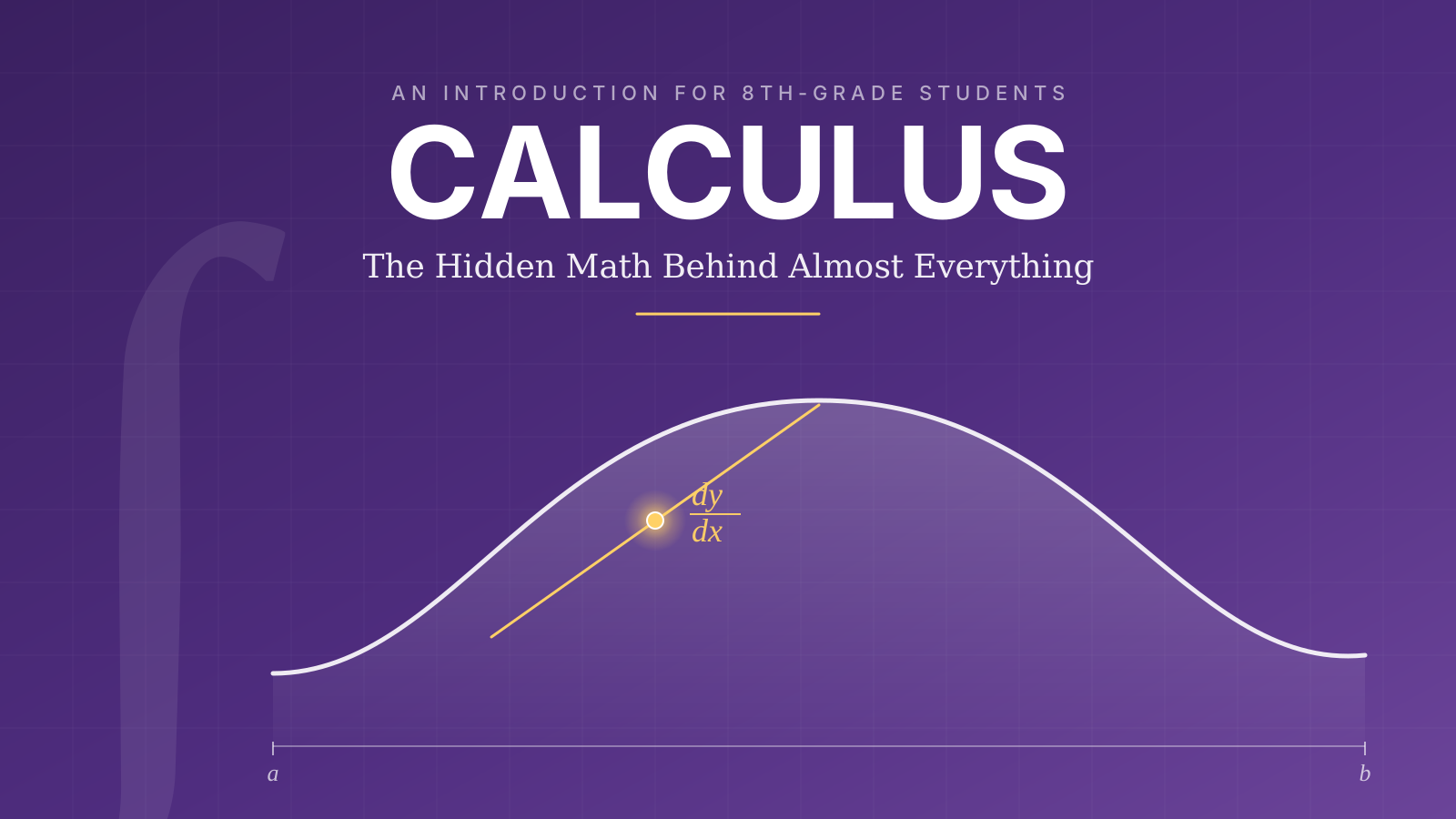
Calculus
The Hidden Math Behind Almost Everything
An introduction for 8th-grade students
Have you ever wondered how engineers know exactly how much force a bridge can hold? Or how video game designers make a character’s jump look perfectly natural? Or how doctors figure out the right dose of medicine to give a patient based on their weight? The answer to all of these questions involves one surprisingly powerful branch of mathematics: calculus.
You may have heard the word "calculus" before — often spoken with a nervous tone by older students. But despite its scary reputation, calculus is actually one of the most useful and creative inventions in the history of math. This article explains what calculus is for, who invented it, where you see it in everyday life, and what you should already know before you start learning it.
1. Why Do We Need Calculus?
Most of the math you’ve learned so far — arithmetic, algebra, geometry — is excellent at describing things that stay the same or change in simple, predictable ways. You can calculate the area of a rectangle whose sides don’t move, or the speed of a car driving steadily at 60 miles per hour.
But the real world rarely sits still.
- A car doesn’t drive at exactly 60 mph the whole trip — it speeds up, slows down, and stops at red lights.
- A growing tree adds wood at different rates throughout the year.
- A roller coaster’s speed changes every fraction of a second as it climbs and falls.
- The temperature outside isn’t constant — it rises and falls throughout the day.
Algebra struggles with these situations because the numbers are always changing. Calculus is the math of change. It gives us tools to answer questions algebra cannot:
- How fast is something changing right at this exact instant?
- If something keeps changing for a while, what’s the total amount of change?
- What’s the perfect size, shape, speed, or angle to get the best result?
These three questions sound simple, but they unlock an enormous amount of real-world problem-solving. Calculus is built around two big ideas: the derivative (which measures how fast something is changing) and the integral (which adds up tiny changes to find a total). You don’t need to understand these yet — just know that together they form a kind of mathematical superpower.
2. Who Invented Calculus?
Calculus has one of the most fascinating origin stories in mathematics. It was invented independently by two brilliant thinkers on opposite sides of Europe, at almost exactly the same time.
Isaac Newton (1643–1727)
Newton was an English scientist who developed his version of calculus around 1666 — when he was just 23 years old and stuck at home from college because of a plague outbreak. He used calculus to explain how planets move around the Sun and how gravity pulls objects toward the Earth. Newton called his invention "the method of fluxions" (fluxion meaning "flowing").
Gottfried Wilhelm Leibniz (1646–1716)
Leibniz was a German mathematician and philosopher who developed calculus a few years later, around 1675. He arrived at the same ideas through a completely different path — focused on pure math problems rather than physics. Importantly, Leibniz invented the elegant symbols we still use today, like the long curvy ∫ for "integral" and dy/dx for "derivative".
The Famous Argument
A bitter feud broke out between the two men (and their followers) over who deserved credit. It got ugly — people accused each other of stealing ideas, and the argument lasted for years. Today, historians agree that they both invented calculus independently. We use Leibniz’s notation but learn the ideas from both of them.
They Weren’t Quite First
Calculus didn’t appear from nothing. Ancient Greek mathematicians like Archimedes (around 250 BC) had already figured out how to calculate the area inside curves and the volume of a sphere — using clever tricks that were the earliest seeds of calculus, almost 2,000 years before Newton and Leibniz finished the job. Other mathematicians like Pierre de Fermat and Isaac Barrow added crucial pieces along the way.
3. How Calculus Solves Real-Life Problems
Calculus isn’t just abstract math in a textbook — it quietly powers an enormous part of the modern world. Here are some places where calculus is hard at work, often invisible to the people benefiting from it:
Field | What Calculus Does |
|---|---|
Space exploration | NASA uses calculus to plan rocket trajectories, design satellite orbits, and safely land rovers on Mars from millions of miles away. |
Medicine | Doctors use calculus to figure out how quickly a drug spreads through the body and when the next dose should be given for safe, effective treatment. |
Video games & animation | Pixar and game studios use calculus to make characters move smoothly, simulate water and fire, and bend light realistically off shiny surfaces. |
Weather forecasting | Supercomputers solve enormous systems of calculus equations to predict storms, hurricanes, and temperature changes days or weeks in advance. |
Smartphones & GPS | Your phone’s GPS uses calculus to figure out exactly where you are by tracking how signals from orbiting satellites change moment by moment. |
Engineering | Engineers calculate the maximum weight a bridge can carry, the best shape for an airplane wing, and the safest curve for a highway exit. |
Music & audio | Streaming apps like Spotify use calculus-based math to compress songs into small files without losing audio quality. |
Sports analytics | Coaches use calculus to optimize a basketball player’s free-throw arc, a sprinter’s stride, or a quarterback’s release angle. |
Economics & business | Companies use calculus to find the most profitable price for a product, predict market changes, and minimize costs. |
Climate science | Climate scientists use calculus models to predict how Earth’s temperature, sea levels, and ice caps will change over the coming decades. |
Notice the pattern — anywhere something is changing, moving, flowing, or being optimized, calculus is probably involved. Whenever you see "predict," "model," "simulate," or "optimize" in a news article, there’s a good chance calculus is doing the heavy lifting behind the scenes.
4. What You Should Know Before Learning Calculus
Here’s the good news: calculus builds on math you’ve already started learning. You don’t need to be a genius. You need a solid foundation in a few specific areas, and you need patience.
Algebra (the most important prerequisite)
- Solving equations with variables (like solving for x in 2x + 5 = 17).
- Working with exponents, roots, and powers.
- Understanding functions — something goes in, something comes out, and there’s a rule that connects them.
- Graphing equations on a coordinate plane and reading those graphs.
- Factoring polynomials and working with quadratic equations.
Geometry
- The slope of a straight line — this turns out to be huge, because calculus is essentially about slopes of curves.
- Areas of shapes (rectangles, triangles, circles) — calculus generalizes this to any shape.
- The Pythagorean Theorem and coordinate geometry.
- Similar triangles and basic proofs.
Trigonometry (usually learned in 10th or 11th grade)
- Sine, cosine, and tangent functions and what they mean for triangles.
- The unit circle and radian measurement of angles.
- How angles relate to each other through identities.
Mindset (just as important as the math)
- Patience. Calculus introduces some surprising new ideas that take time to click. That’s normal — even Newton and Leibniz worked on these ideas for years.
- Curiosity. Asking "why does this work?" is more useful than memorizing rules. Calculus rewards students who think about what the math is actually saying.
- Comfort with abstraction. Variables, functions, and "what if?" questions — the more comfortable you are with abstract thinking, the easier calculus becomes.
- Willingness to make mistakes. You will get things wrong, often. That’s how the ideas get sharper. The students who do best are the ones who don’t give up.
When Will You Actually Take Calculus?
Most students take their first calculus class in their senior year of high school (12th grade) or the first year of college. Some advanced students take it in 11th grade. A handful of accelerated students start even earlier. But many of the ideas behind calculus — like rates of change, slopes, and area under a curve — actually start showing up in pre-algebra and algebra class. You’re already meeting calculus, you just don’t know it yet.
Putting It All Together
Calculus is the language we use to describe a world that’s constantly moving and changing. From the orbit of a planet to the bounce of a basketball, from the growth of a tree to the click of a phone’s GPS, calculus is quietly running in the background of modern life.
The best part? Everything you learn between now and high school — every algebra problem, every geometry proof, every trig identity — is laying the foundation for calculus. So don’t worry about it being hard later. Worry about being a strong, curious math student now, and the rest will take care of itself.
— — —
Keep asking questions. Keep noticing patterns. That’s how math works.
Discussions
No discussions yet. Be the first to start one.